TL;DR
Blue Astral audited 410 PEG stations and found universal infrastructure failures: 100% lack server compression and caching. Over half are missing the SEO fundamentals Google needs to surface their content. This report reveals the four structural barriers keeping your station out of search results and the path forward to reclaim your place in the digital town square.
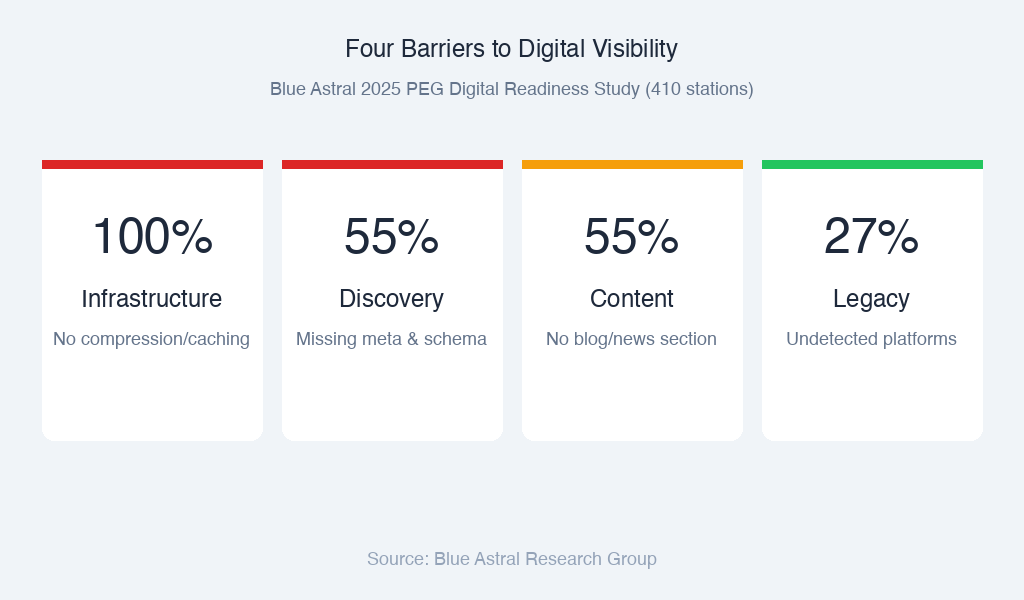
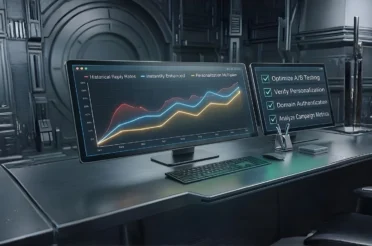
Blue Astral’s 2025 audit of 410 PEG stations revealed four critical infrastructure gaps.
The Promise vs. The Reality
Public Access Television was built on a promise: give the community a voice, and the community will listen.
For forty years, that promise held. Cable subscribers tuned in. City councils relied on you. School boards streamed their meetings through your infrastructure. The “Town Square” worked because everyone knew where it was.
But the Town Square has moved. It’s no longer on Channel 15. It’s on Google. And when Blue Astral audited 410 PEG stations across the United States, we discovered something alarming:
100% of stations lack basic server optimization. Not most. Not the majority. Every single station we analyzed is missing compression and caching, the foundational technologies that determine whether your page loads in 1 second or 10.
The gates to the digital town square aren’t just closed. They were never built.
What We Found: Four Barriers to Digital Visibility
1. The Universal Infrastructure Crisis (100%)
Every station we analyzed lacks two foundational web technologies:
Server Compression (0% have it): Compression (gzip/brotli) reduces file sizes by 60-80% before transmission. Without it, your pages are 3-5x larger than they need to be. A civic meeting page that should load in 2 seconds takes 8.
Cache Control (0% have it): Cache headers tell browsers to store unchanged content locally. Without them, visitors re-download your entire site on every visit. Repeat viewers get the same slow experience every time.
Since 2021, Google’s Core Web Vitals (page speed metrics) are official ranking factors. A slow site doesn’t just frustrate visitors; it signals low quality to search algorithms.
This is the easiest gap to close. Compression and caching are server configuration changes, not redesigns. Most hosting providers can enable them in minutes.
2. The Discovery Gap (55%)
Even when your content loads, Google needs structured signals to understand what it is and show it to searchers.
54.9% (225 stations) lack meta descriptions. These 150-160 character summaries appear below your page title in search results. Without them, Google generates arbitrary excerpts that often fail to communicate relevance. A searcher looking for “city council meeting January 2024” sees a jumbled snippet and clicks elsewhere.
48.3% (198 stations) have no Schema.org structured data. Schema markup tells Google explicitly: “This is a government meeting video recorded on this date.” Without it, your content competes with commercial media that has proper markup.
39.5% (162 stations) are missing Open Graph tags. When someone shares your content on Facebook or LinkedIn, OG tags control the preview image and description. Missing tags mean broken or unappealing link previews.
3. The Content Silence (55%)
54.9% (225 stations) have no blog or news section.
Search engines prioritize fresh content. A site that hasn’t published new text content in months signals “abandoned” to Google’s algorithms, even if you’re broadcasting live every day.
Video content alone doesn’t solve this. Google can’t watch your videos. It reads text: titles, descriptions, transcripts, blog posts. Without written content, your daily productions are invisible to search.
The fix isn’t high-volume publishing. Even 2-3 posts per month, a meeting recap, a programming highlight, a community announcement, signals activity and gives Google text to index.
4. The Legacy Trap (27%)
27.3% (112 stations) run on platforms our automated tools couldn’t identify: custom-built systems, heavily modified legacy platforms, or outdated technology stacks.
These stations face compounding challenges:
- Security patches may not exist
- Modern SEO features require custom development
- Platform migrations are complex and expensive
- Staff training resources are unavailable
Stations on identified platforms (WordPress at 40.7%, plus Wix, Squarespace, Drupal) have clear upgrade paths. The 27% on legacy systems may need full platform replacements to address the other three barriers.
What’s Working: Strengths to Build On
The audit wasn’t all gaps. PEG stations have built solid foundations in several areas:
Mobile Responsiveness (90.2%): Nine in ten stations have mobile viewport tags, meaning sites adapt to phone screens. This is a relative bright spot, likely driven by modern CMS defaults.
HTTPS Adoption (100%): Every analyzed station has basic encryption enabled. This baseline security requirement is universally met.
Sitemap Presence (77.8%): Over three-quarters have XML sitemaps, giving Google a structured index of their content. This is better than many commercial sectors.
SSL Validity (91.2%): Most stations maintain current SSL certificates, avoiding the browser security warnings that deter visitors.
These strengths provide a foundation. The path forward is closing the infrastructure and discovery gaps while maintaining what’s already working.
The Path Forward: Three Strategic Solutions
1. Fix the Universal Infrastructure Gap
Addresses: Performance (100% gap)
This is the highest-impact, lowest-effort fix. Server compression and cache control are configuration changes, not redesigns.
Action steps:
- Contact your hosting provider and request gzip/brotli compression be enabled
- Ask for cache-control headers with appropriate TTL (time-to-live) values
- If using a CDN (54.6% of stations do), ensure it’s configured for compression and caching
- Test with Google PageSpeed Insights before and after
Expected impact: 40-60% reduction in page load time. Improved Core Web Vitals scores. Better search rankings.
2. Automate SEO Fundamentals
Addresses: Discovery Gap (55% gap)
Modern CMS platforms can generate meta descriptions, schema markup, and OG tags automatically. This turns SEO from a manual chore into a built-in workflow.
Action steps:
- Install SEO plugins (Yoast or RankMath for WordPress; built-in for Wix/Squarespace)
- Create meta description templates for common content types
- Add VideoObject schema to meeting archives
- Configure OG tags for social sharing
Expected impact: Improved search result snippets. Higher click-through rates. Better social media link previews.
3. Build Content Momentum
Addresses: Content Silence (55% gap)
A documented publishing rhythm signals activity to search engines. This isn’t about volume; it’s about consistency.
Action steps:
- Commit to 2-4 text posts per month (meeting recaps, programming highlights, community announcements)
- Create a simple editorial calendar
- Repurpose video content as text: transcripts, summaries, key quotes
- Add a “Latest News” section to your homepage
Expected impact: Improved freshness signals. More indexed pages. More entry points for searchers.
The Blue Astral Approach
At Blue Astral, we don’t build generic websites. We engineer Community Media Hubs: digital platforms optimized for local search, civic transparency, and long-term scalability.
Our approach:
- Audit: Map your current infrastructure gaps (compression, caching, SEO, content)
- Architect: Design solutions that meet modern standards within your budget
- Automate: Implement workflows that reduce manual labor while improving visibility
Does Your Station Pass the Test?
Blue Astral is offering a complimentary Digital Visibility Audit for PEG Station Managers. We’ll analyze your server configuration, SEO fundamentals, and content infrastructure and provide a clear roadmap to close the gaps.
Sources & Verification
This report is based on the Blue Astral 2025 PEG Digital Readiness Study, a technical audit of 410 community broadcasters.
- Core Web Vitals as Ranking Factor: Google Search Central: Page Experience Ranking Signal
- Page Speed & Performance: Google web.dev: The Business Impact of Core Web Vitals
- Mobile Performance & Bounce Rates: Google: Mobile Page Speed Benchmarks
- Content Freshness Ranking: Google Search Central: A Guide to Google Search Ranking Systems
- Local SEO Strategy: Bluewing: The Ultimate Guide To Local SEO For Community Outreach
- On-Page SEO Fundamentals: Fitz Designz: The 5 Most Significant On-Site SEO Factors
- Civic Transparency: Switchboard Live: How Live Streaming City Council Meetings Can Foster Trust