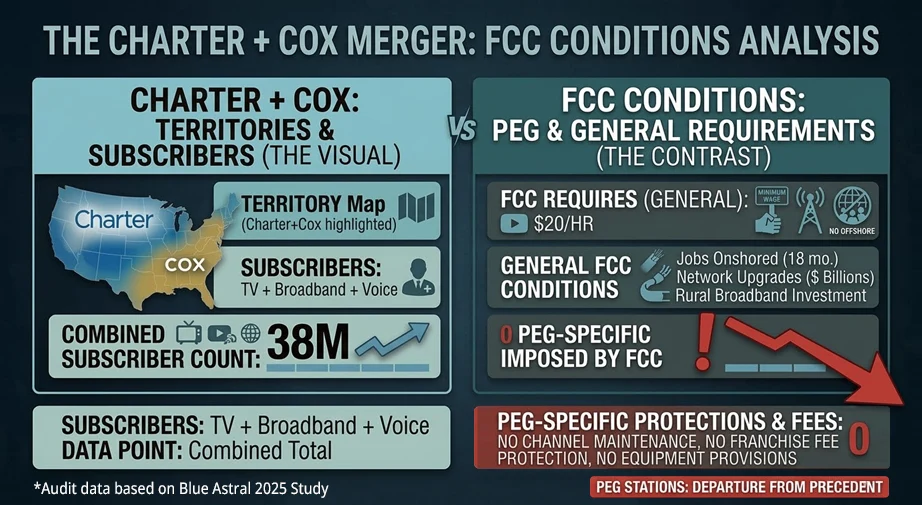
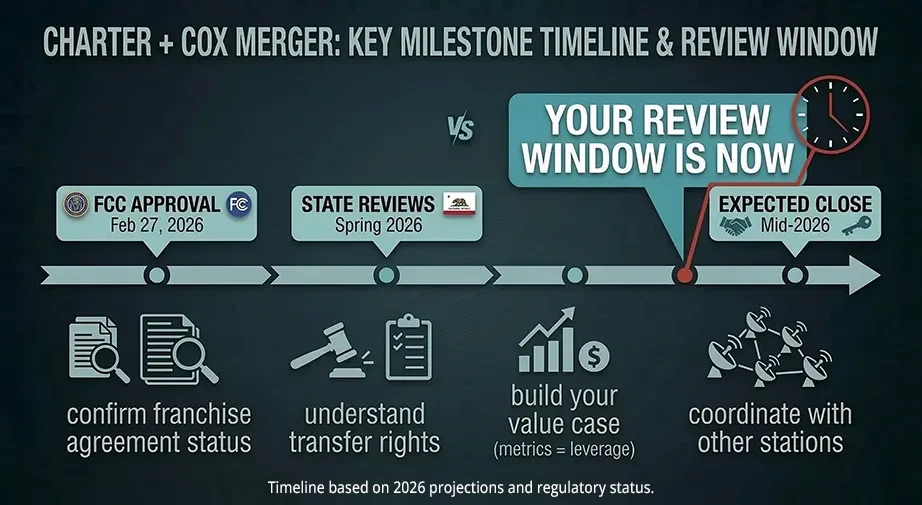
The FCC approved Charter Communications’ $34.5 billion acquisition of Cox Communications on February 27, 2026. The combined entity will serve approximately 38 million subscribers, making it the largest cable and broadband provider in the country. The deal is expected to close by mid-2026.
If your PEG station operates in a Charter or Cox franchise territory, this cable franchise transfer directly affects your agreement. The transfer requires your local government’s approval. And that approval process is a rare opening to review, and potentially renegotiate, the terms that govern your station’s channel position, funding formula, and equipment provisions.
Preparation makes the difference.
What the FCC Did and Did Not Require
The FCC imposed conditions on the merger. Charter must onshore all offshore Cox jobs within 18 months. It must extend a $20/hour minimum wage to Cox workers. It must invest billions in network upgrades and rural broadband.
What the FCC did not impose is more relevant to PEG stations: no PEG-specific conditions. No requirements to maintain channel positions. No franchise fee protections. No equipment provisions.
This is a departure from precedent. The 2016 Charter-Time Warner Cable merger came with affordability requirements, data cap restrictions, and interconnection conditions. None of those appeared in this approval. Public Knowledge, the Benton Institute for Broadband & Society, and other advocacy organizations petitioned to deny the merger, citing concerns about “unchecked gatekeeper power” over internet distribution.
The absence of federal PEG protections means one thing: the only safeguards for your station are in your local franchise agreement.
Why the Franchise Transfer Is a Budget Defense Moment
Under Section 617 of the Cable Act, no transfer of a cable franchise can occur without “prior written consent” of the franchising authority, which is your local government. This is not a rubber stamp. It is a review and approval process.
When a franchise transfers, the franchising authority has the legal standing to examine the existing agreement, ask questions about the new operator’s plans, and negotiate updated terms before granting consent.
For PEG stations, the provisions worth reviewing include:
- Channel position. Cable operators have increasingly moved PEG channels to higher channel numbers on digital-only tiers, reducing viewership. The transfer review is an opportunity to lock in favorable channel assignments.
- Funding formula. Franchise fees are capped at 5% of gross cable revenue, but the calculation method (what counts as “gross revenue”) can vary. Clarifying or strengthening this language protects against revenue erosion beyond cord-cutting.
- Equipment and facilities. Many franchise agreements include provisions for studio equipment, mobile production units, or dedicated fiber connections. These age out. A transfer is a natural moment to update equipment schedules.
- I-Net and digital provisions. Institutional network (I-Net) commitments and support for digital/OTT distribution are increasingly relevant as stations expand beyond cable.
Law firm Best Best & Krieger (BBK) has published a Local Cable Franchise Transfer Toolkit specifically for this merger, advising communities to review their transfer rights and prepare for the consent process.
The Problem: Negotiating Without Data
Franchise negotiations are stronger when the station can demonstrate its community value. A city council or county board considering whether to press for better PEG terms needs evidence that the station serves residents, that people watch the content, that civic programming reaches the community.
Most stations cannot provide that evidence. They lack basic analytics on their websites, have no way to report streaming viewership, and cannot quantify community engagement. The gap between the value PEG stations deliver and their ability to document that value becomes a liability during franchise negotiations.
A station that can show its city council viewership data, streaming metrics, and community engagement numbers is in a fundamentally different negotiating position than one that cannot.
What PEG Stations Should Do Before Mid-2026
The merger is expected to close by mid-2026. California’s Public Utilities Commission still needs to approve the deal, but the FCC’s approval covers the majority of franchise territories. For most stations in Charter or Cox service areas, the transfer process is underway or imminent.
Step 1: Confirm your franchise agreement status. Locate your current agreement and identify the specific PEG provisions. Note expiration dates, channel position language, funding formulas, and equipment schedules. If you don’t have a copy, your city clerk or municipal attorney should.
Step 2: Understand your transfer rights. Section 617 gives your franchising authority the right to review and approve the transfer. Talk to your municipal attorney about what that process looks like in your jurisdiction. BBK’s franchise transfer toolkit is a practical starting point.
Step 3: Build your value case. This is the harder step, and the one with the longest lead time. If your station lacks analytics, implementing basic tracking now gives you months of documented engagement before any negotiation. Even simple metrics, such as website visits, stream views, and content downloads, change the conversation from “we provide a public service” to “we documented 15,000 hours of civic content consumed last quarter.” That shift gives your city council a reason to push for stronger PEG terms in the transfer consent.
Step 4: Coordinate with other stations. PEG stations in the same franchise territory share the same transfer event. Coordinating with neighboring stations on shared concerns (channel positions, funding floors, equipment refresh cycles) strengthens everyone’s position.
A Constraint Worth Acknowledging
Not every municipality has the legal resources to negotiate aggressively during a franchise transfer. Smaller communities may lack specialized telecom counsel. The transfer review is mandatory, meaning the moment happens whether or not the municipality is prepared, but preparation makes the difference between a rubber-stamp consent and a meaningful review.
Even municipalities without deep legal resources can present a stronger case when they have data showing community engagement and service delivery.
The Larger Pattern
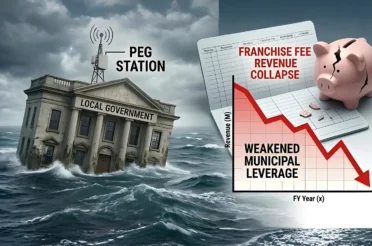
The Charter-Cox merger is one event in a broader trend. Cable subscriptions dropped from 96 million to 68 million between 2017 and 2024, and franchise fee revenue is declining with them. The franchise transfer is a specific, time-bound opportunity to strengthen your station’s position before the next budget cycle. Blue Astral’s Budget Defense Playbook covers the broader strategy.
FAQ
Q: Does the Charter-Cox merger affect my PEG station’s franchise agreement?
A: Yes. If your station operates in a Charter or Cox franchise territory, the franchise agreement will transfer to the new combined entity. Under Section 617 of the Cable Act, your local government must consent to that transfer, creating a window to review and potentially update PEG provisions including channel positions, funding formulas, and equipment commitments.
Q: Did the FCC impose any PEG protections as part of the merger approval?
A:
No. The FCC imposed conditions related to jobs, wages, and network investment, but no PEG-specific requirements. No channel position protections, no franchise fee safeguards, and no equipment provisions. The only PEG protections are those in your local franchise agreement.
Q: When does this franchise transfer happen?
A: The merger is expected to close by mid-2026. California’s Public Utilities Commission must still approve the deal, but the FCC’s approval covers the majority of franchise territories. Stations in Charter or Cox service areas should begin reviewing their franchise agreements now.
Q: What is the BBK franchise transfer toolkit?
A: Best Best & Krieger (BBK), a law firm specializing in municipal law, has published a Local Cable Franchise Transfer Toolkit advising communities on their rights during the Charter-Cox transfer process. It covers what to review, what questions to ask, and how to prepare for the consent process.
Sources:
- FCC Approves Charter-Cox Combination – Official FCC document
- FCC Approves $34.5 Billion Charter-Cox Merger – Broadband Breakfast coverage
- Charter-Cox Merger Gets FCC Approval – Hollywood Reporter coverage
- FCC Formally Approves Cox/Charter Merger – Public Knowledge analysis
- BBK Local Cable Franchise Transfer Toolkit – Practical guide for communities
- Cable Franchising Authority of State and Local Governments – Congressional Research Service report
- FCC PEG Channels Overview – FCC reference
- FCC Merger Conditions – Engadget coverage
- Blue Astral 2025 PEG Digital Readiness Study – Proprietary audit of 410 stations