If you’re a growth-stage founder spending $5K-$15K/month on outbound, you’ve probably been quoted a 10% reply rate. Maybe higher. The agency showed you a case study, pointed to a few winning campaigns, and built the proposal around those numbers.
The problem is, you had no way to check. Until now.
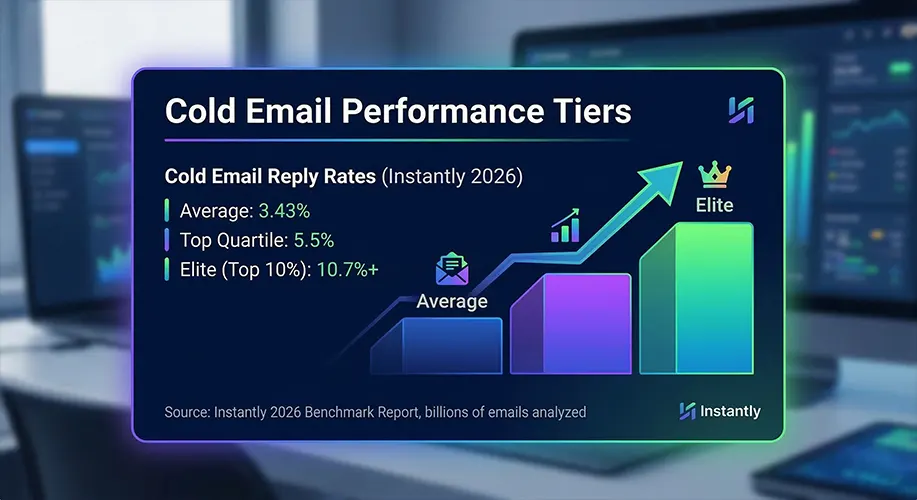
Instantly just published its 2026 Cold Email Benchmark Report, analyzing billions of cold email interactions across more than 700,000 businesses. The real average reply rate? 3.43%.
That 10% number your agency promised? It exists. But it sits in the top 10% of all campaigns measured. The top quartile hits 5.5%. Elite performers, the top decile, reach 10.7% or higher. Your agency sold you elite-tier performance as a baseline expectation.
Bad benchmarks lead to bad budget decisions. When a founder planning for 10% reply rates gets 3.43%, they don’t question the benchmark. They fire the SDR, switch agencies, or abandon the channel entirely. The problem was never the execution. It was the expectation.
What Separates 3.43% from 10.7%
The gap between average and elite is not copywriting talent. It’s system design.
Four structural differences separate top-performing campaigns from the average:
- Micro-segmentation over broad lists. Elite campaigns don’t target “SaaS companies with 50-200 employees.” A growth-stage DTC brand selling $200+ products, for example, would target “ecommerce teams that just hired a VP of Growth and are scaling paid acquisition.” Autobound’s 2026 analysis found that emails referencing specific buying signals (funding rounds, leadership changes, hiring surges) achieve 15-25% response rates. That’s a 5x improvement over the average, but it requires real signal infrastructure, not a purchased list.
- Brevity that forces clarity. Emails under 80 words outperform longer copy across the Instantly dataset. This isn’t a formatting trick. Short emails force you to lead with the prospect’s problem, not your product. When you only have 80 words, every sentence must earn its place.
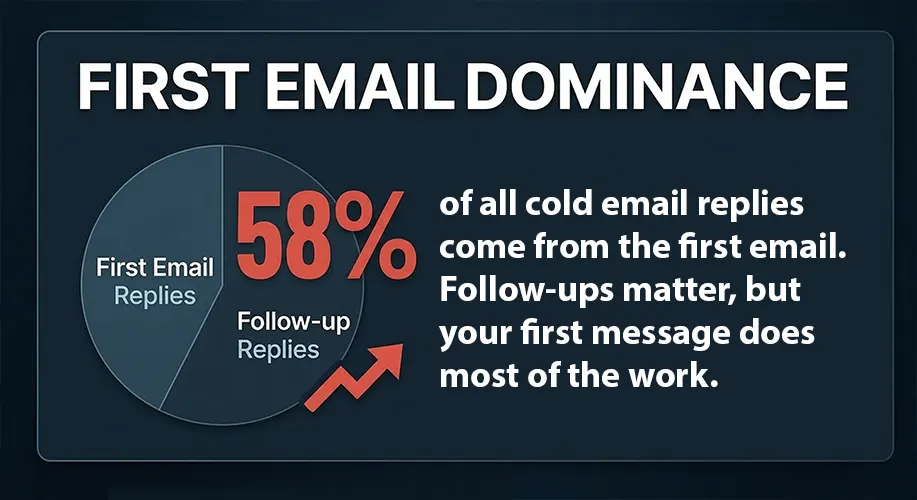
- Structured sequences, not spray-and-pray. The optimal sequence length is 4-7 emails, spaced 3-4 days apart. Saleshandy’s analysis of 100M+ emails found that campaigns with 3-5 follow-up steps hit 8.3% reply rates compared to 4.1% for single-email sends. But here’s the number that should shape your sequence design: 58% of all replies come from the first email. Follow-ups matter, but the first email does most of the work.
- Weekly A/B testing discipline. Top performers in Instantly’s dataset test new messaging every week. Not quarterly. Not “when we get around to it.” Weekly. The Autobound framework recommends structured 8-week testing cycles: establish baseline, test hook types, test cadence variations, test personalization depth. Each variant needs 300-500 recipients and 48-72 hours to produce statistically valid results.
If your outbound is built on assumptions instead of these benchmarks, we’ll tell you where your campaigns actually fall – and what to fix first.
The Personalization Gap Is Worse Than You Think
Personalization is the single largest lever in cold email performance. Saleshandy’s data shows personalized subject lines generate a 30.5% higher response rate. Personalized body content adds another 32.7%. Combined, full personalization can increase reply rates by up to 142%.
But only 5% of cold email senders actually personalize every email they send.
This is the real competitive advantage. Not AI-generated copy (which most agencies now use as a baseline), but genuine signal-based personalization that references the prospect’s specific situation. The 71% of decision-makers who ignore cold emails that don’t address their specific needs aren’t being difficult. They’re being rational.
Why “Cold Email Is Dead” Is Wrong (and Why It Doesn’t Matter)
Reply rates have remained stable despite growing volume. The channel works. But it works as a precision instrument, not a volume play.
The agencies claiming 10%+ reply rates are either cherry-picking their best campaigns or genuinely operating at the elite tier. Both scenarios are fine, but a growth-stage company evaluating outbound needs to know which one it’s getting. When your agency says “we typically see 10% reply rates,” the right follow-up question is: “Across how many campaigns, and what’s the median?”
The more important question for a growth-stage company spending $5M-$75M is whether cold email is the right channel to over-index on. At Blue Astral, we see cold email as one component of an integrated acquisition system. It excels at demand creation for specific segments with clear buying signals. It’s poor at broad awareness, brand building, or reaching prospects who aren’t in-market. For companies that have outgrown referral-only growth, the real question isn’t “should we do cold email?” It’s “what percentage of our acquisition budget should cold email represent, given these benchmarks?”
What This Means for Your 2026 Outbound Budget
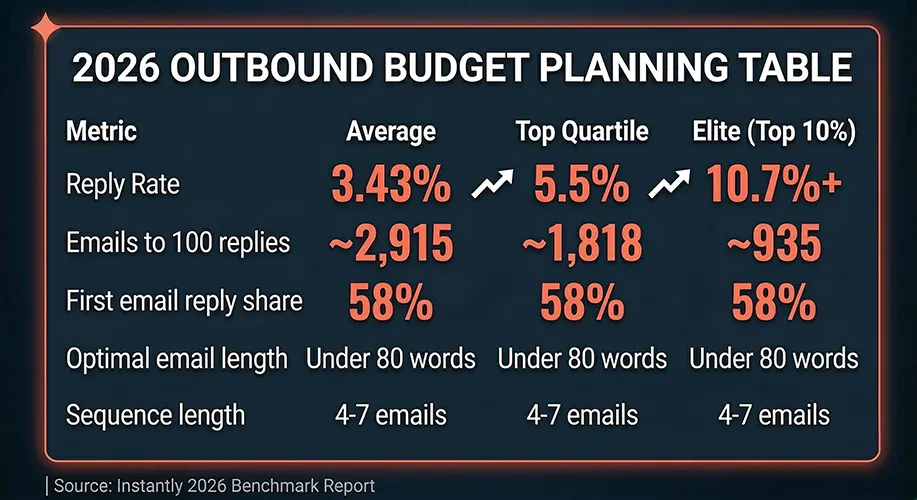
Honest planning starts with honest numbers:
| Metric | Average | Top Quartile | Elite (Top 10%) |
| Reply rate | 3.43% | 5.5% | 10.7%+ |
| Emails to 100 replies | ~2,915 | ~1,818 | ~935 |
| First email reply share | 58% | 58% | 58% |
| Optimal email length | Under 80 words | Under 80 words | Under 80 words |
| Sequence length | 4-7 emails | 4-7 emails | 4-7 emails |
Budget for the average. Build toward the top quartile. Treat elite performance as the ceiling, not the floor.
If your agency can’t tell you where their median campaign falls on this spectrum, that’s diagnostic. The agencies operating at the elite tier know exactly where they stand because they measure it. The ones that don’t measure it are the ones quoting 10%.
Blue Astral runs free outbound audits for growth-stage companies. We’ll benchmark your current campaigns against this data, identify the gaps, and show you where your acquisition budget is working and where it’s leaking. Get your outbound audit.
FAQ
Q: What is a good cold email reply rate in 2026?
A: Based on Instantly’s 2026 benchmark data analyzing billions of emails across 700K+ businesses, 3.43% is the average cold email reply rate. A good reply rate falls in the top quartile at 5.5%. Elite campaigns (top 10%) achieve 10.7% or higher.
Q: How long should a cold email be?
A: Under 80 words. Instantly’s data shows shorter emails consistently outperform longer ones. This forces problem-first positioning and a single clear call to action, which are the two elements that drive replies.
Q: How many follow-up emails should a cold email sequence include?
A: The optimal cold email sequence is 4-7 emails, spaced 3-4 days apart. However, 58% of all replies come from the first email, so the initial message carries the majority of the workload. Sequences with 3-5 follow-ups achieve 8.3% reply rates versus 4.1% for single sends.
Q: Does personalization actually improve cold email reply rates?
A: Significantly. Personalized subject lines improve response rates by 30.5%, and personalized body content adds 32.7%. But only 5% of senders personalize every email. The gap between “we personalize” and actually doing it at scale is where most campaigns underperform.
Sources:
- Instantly Cold Email Benchmark Report 2026 – Primary benchmark data (billions of emails, 700K+ businesses)
- Autobound Complete Guide to Cold Email in 2026 – Signal-based strategy framework, A/B testing methodology
- Saleshandy Cold Email Statistics (100M+ Emails) – Personalization impact data, sequence performance