A Small Station, A Big Win
At the February 2026 ACM West Conference, Access Humboldt walked away with 6 WAVE Awards. They won across six categories: Educational Access, Community Issues, Underserved Voices, Community Event, News/Documentary/Magazine, and Government Access.
Access Humboldt operates in DMA #196 out of 210 TV markets. They serve 59,670 TV households across 5,282 square miles of rural Northern California. Their annual revenue is roughly $533,000. They’re currently facing a forced relocation after their lease was terminated early.
They competed against stations from markets like Pasadena, which sits in DMA #2, the Los Angeles market. They won anyway.
Executive Director Christina Marie Jeffers put it plainly: “This is truly a David and Goliath story. There are 195 TV markets with far greater funding for their PEG stations. For our small, rural station to win six WAVE awards is an incredible honor.”
The content quality is real. The problem is PEG station website discoverability: what happens after the award ceremony.

The PEG Station Discoverability Gap
Search for “Access Humboldt WAVE Awards” today. The results you’ll find are from Kym Kemp (a local news blog) and the Times-Standard (the regional newspaper). The station’s own website doesn’t surface the story.
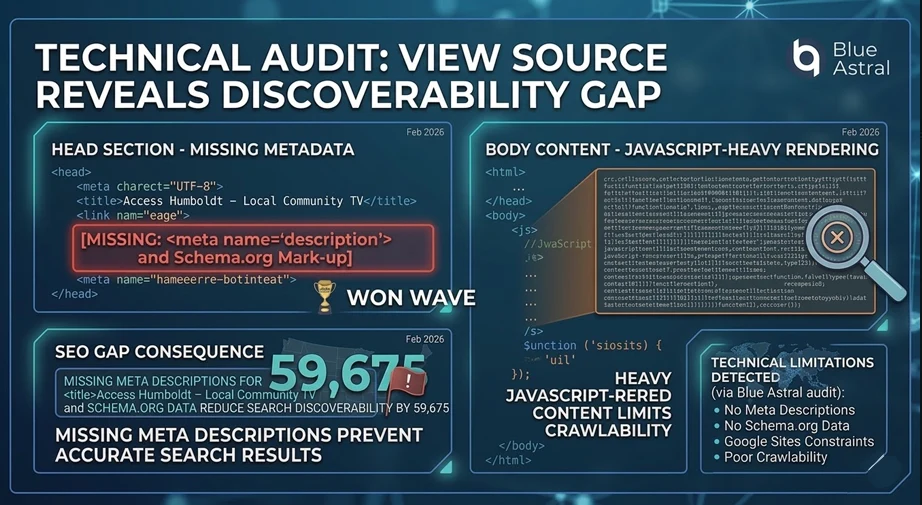
Access Humboldt’s site is built on Google Sites, a free platform with significant limitations: no meta descriptions, no schema markup, no H1/H2 hierarchy for search engines, no blog or news section to publish updates, and heavy JavaScript rendering that limits crawlability.
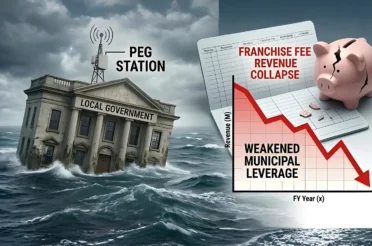
This isn’t a criticism of Access Humboldt. They’re operating on a budget that’s running a $75,000 annual deficit while their franchise fee revenue drops from roughly $77,000 per quarter to $62,000. They’re making reasonable tradeoffs with limited resources.
But it illustrates a pattern Blue Astral sees across the entire sector.
Why Most PEG Station Websites Fail at SEO
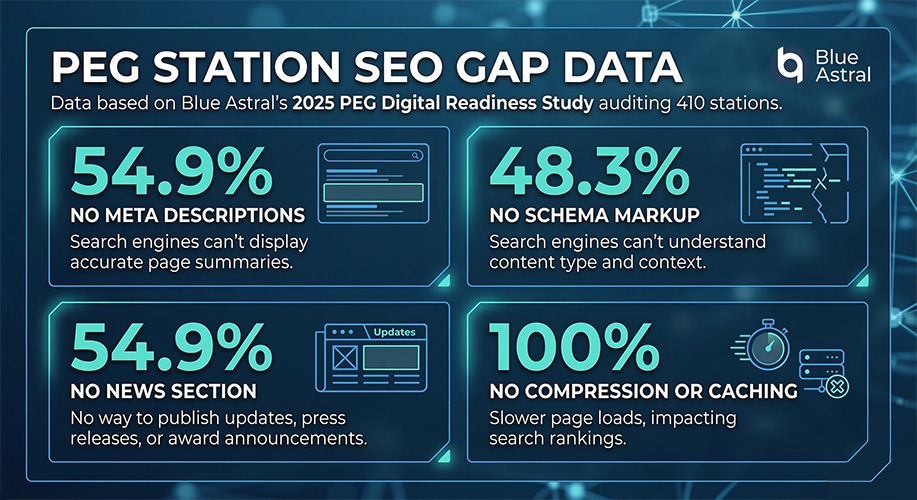
Blue Astral’s 2025 PEG Digital Readiness Study, auditing 410 PEG stations with dedicated websites, found the same gaps repeated across the country:
| Issue | % of Stations | SEO Impact |
| No meta descriptions | 54.9% | Search engines can’t display accurate page summaries in results |
| No Schema.org structured data | 48.3% | Search engines can’t understand content type and context |
| No blog or news section | 54.9% | No way to publish updates, press releases, or award announcements |
| No server compression or caching | 100% | Slower page loads, lower search rankings |
| Unknown legacy platforms | 27.3% | Limited or no ability to implement SEO improvements |
These aren’t cosmetic issues. They determine whether a station’s content appears in search results at all.
When a Humboldt County resident searches for local government meetings, community programming, or civic events, Access Humboldt’s award-winning content competes for visibility with every other result on the page. Without basic SEO infrastructure, it loses that competition regardless of how good the content is.
How Website Discoverability Drives PEG Station Funding
The discoverability gap creates a downstream budget problem. PEG stations increasingly need to demonstrate community reach to justify their funding. Stations like NCTV17 in Naperville secured a funding increase to $915,000 after demonstrating measurable value to their city council. Stations that can’t document their reach end up in situations like Hudson, NH, where the community television station had to put its funding to a public ballot vote.
Digital discoverability isn’t separate from budget defense. It’s a prerequisite. A station that can show search traffic, video views, and engagement data has a fundamentally different conversation with its city council than one that can only point to cable channel numbers.
Do PEG Stations Really Need SEO?
A reasonable objection: PEG stations serve local communities. Their audience already knows they exist. Why invest in search visibility when the viewer base is defined by geography, not discovery?
Two reasons. First, “already knows” is less true every year. As cable subscribers decline, the share of residents who encounter PEG content through channel surfing shrinks. New residents, younger demographics, and cord-cutters need to find the station online. Second, search visibility isn’t just about attracting viewers. It’s about generating the engagement data that justifies funding. A station that appears in search results gets measurable traffic. Measurable traffic becomes the budget defense argument that “we serve the community” can’t make on its own.
How PEG Stations Can Fix Their Website Discoverability
The fixes aren’t exotic. For most PEG stations, the highest-impact changes are straightforward:
Add meta descriptions to every page. This is the single most impactful SEO fix for the 54.9% of stations missing them. It tells search engines what the page is about and gives users a reason to click.
Help your station appear as the local institution it is in search results. Adding Schema.org markup (LocalBusiness, Organization, and VideoObject types) tells search engines what your station does and where it operates, so your content surfaces when residents search for local programming.
Publish a news or updates section. Regular content signals to search engines that the site is active. Award wins, meeting schedules, programming highlights. The content already exists; it just needs a home on the website.
Move off platforms that can’t support SEO. Google Sites, Wix free tier, and similar platforms impose structural limitations that no amount of content quality can overcome. The 40.7% of stations on WordPress have a foundation to build on. Others may need to evaluate a platform migration.
Access Humboldt’s story is worth celebrating. A station with a $533,000 budget and a shrinking revenue base produced content that beat stations with far greater resources. That’s exactly the kind of story that builds public support for community media.
But if the station’s own website can’t surface that story to the community it serves, the impact stays inside the award ceremony. Blue Astral’s work focuses on closing that gap: turning the content quality that PEG stations already have into the measurable digital presence that secures their funding.
See how your station’s digital presence compares with a free Blue Astral audit.
Frequently Asked Questions
Q: Why do PEG stations struggle with search visibility?
A: Most PEG stations operate on limited budgets and use free or low-cost website platforms that lack SEO capabilities. Blue Astral’s study of 410 stations found that over half lack meta descriptions and blog sections, and nearly half have no structured data markup.
Q: Does SEO matter for a local community TV station?
A: Yes. As cable viewership declines, online discoverability becomes the primary way new residents and cord-cutters find local programming. Search traffic also generates the measurable engagement data that stations need when defending their budgets to city councils.
Q: What is the easiest SEO fix for a PEG station website?
A: Adding meta descriptions to every page. This single change helps search engines understand and display your content in results. It requires no technical expertise on most platforms and directly improves click-through rates from search.
Sources:
- Kym Kemp – Access Humboldt wins 6 WAVE Awards at ACM West – Feb 21, 2026
- Times-Standard – Access Humboldt wins multiple WAVE Awards – March 1, 2026
- Colorado Boulevard – Pasadena Media earns multiple honors at 2026 WAVE Awards – Feb 2026
- NCTV17 – Naperville city council supports raising SECA cap – 2025
- Hudson Times – Selectmen warned of accelerating revenue decline at HCTV – Jan 2026
- Blue Astral 2025 PEG Digital Readiness Study – 2025