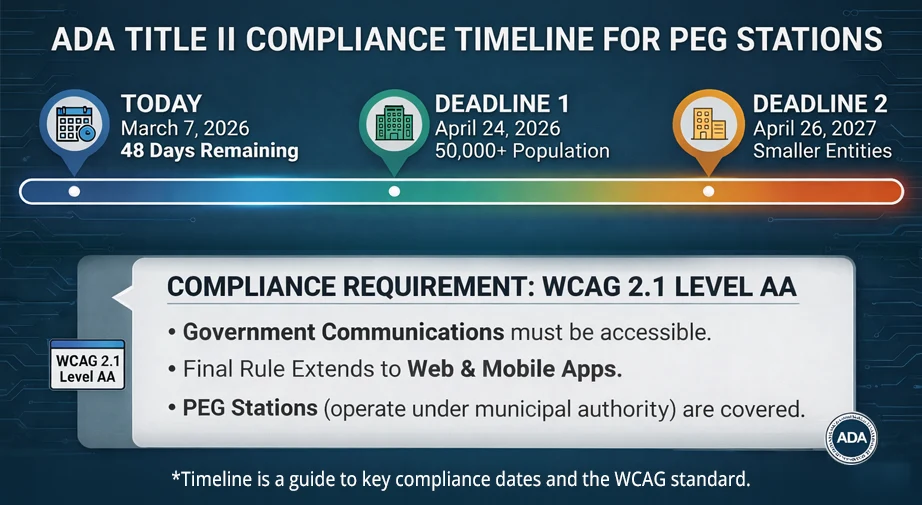
On April 24, 2026, the DOJ’s ADA Title II rule takes effect for all public entities serving populations over 50,000. Every government website must meet WCAG 2.1 Level AA accessibility standards. Penalties reach $150,000 per violation.
That is 48 days from today (as of March 7, 2026).
This deadline has received limited attention in the PEG community. It likely applies to most stations.
Why ADA Title II Applies to PEG Stations
ADA Title II covers every program, service, and activity provided by state and local government entities. The DOJ’s final rule extends this to web content and mobile applications, establishing WCAG 2.1 Level AA as the mandatory technical standard.
PEG stations sit squarely in this scope. Most operate under municipal authority. They receive funding through cable franchise fees assessed by local governments. They broadcast government meetings, public hearings, and civic programming. As Link Electronics documented, ADA Title II does apply to PEG channels, and the Effective Communications Requirement means government communications must be as accessible to people with disabilities as to anyone else.
The question is not whether PEG stations should pursue accessibility. The question is whether they are ready to meet a specific compliance standard, with enforcement teeth, on a specific date.
What WCAG 2.1 Level AA Requires
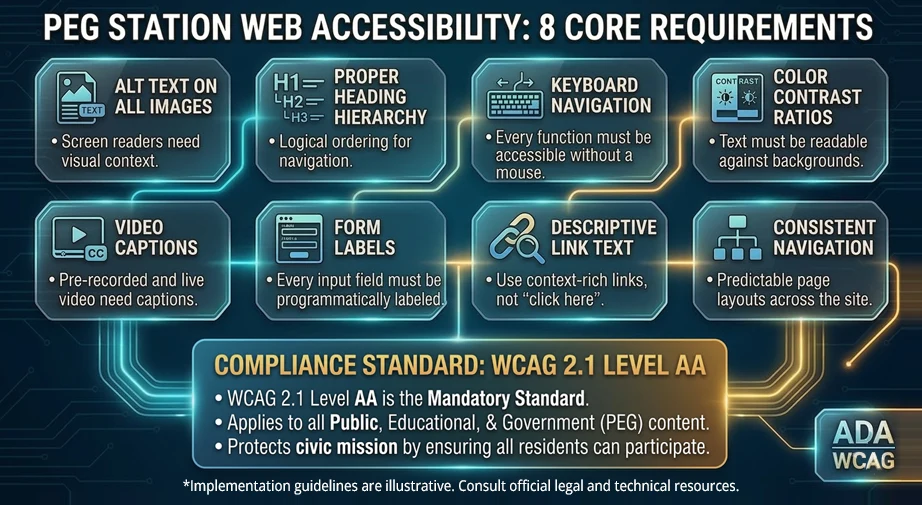
WCAG 2.1 Level AA is a set of technical guidelines covering four principles. Web content must be perceivable, operable, understandable, and robust.
In practice, that means your website must work for residents using screen readers, keyboard-only navigation, and other assistive technologies:
| Requirement | What it covers |
| Alt text on all images | Screen readers need text descriptions of visual content |
| Proper heading hierarchy | H1, H2, H3 in logical order for navigation |
| Keyboard navigation | Every function accessible without a mouse |
| Color contrast ratios | Text must be readable against background colors |
| Video captions | All pre-recorded and live video needs captions |
| Form labels | Every input field must be programmatically labeled |
| Descriptive link text | No “click here” links |
| Consistent navigation | Predictable page layouts across the site |
For PEG stations, the video captioning requirement is especially significant. Stations hosting archived council meetings, public hearings, or educational programming on their websites must ensure every video is captioned.
What Blue Astral’s Audit Data Suggests
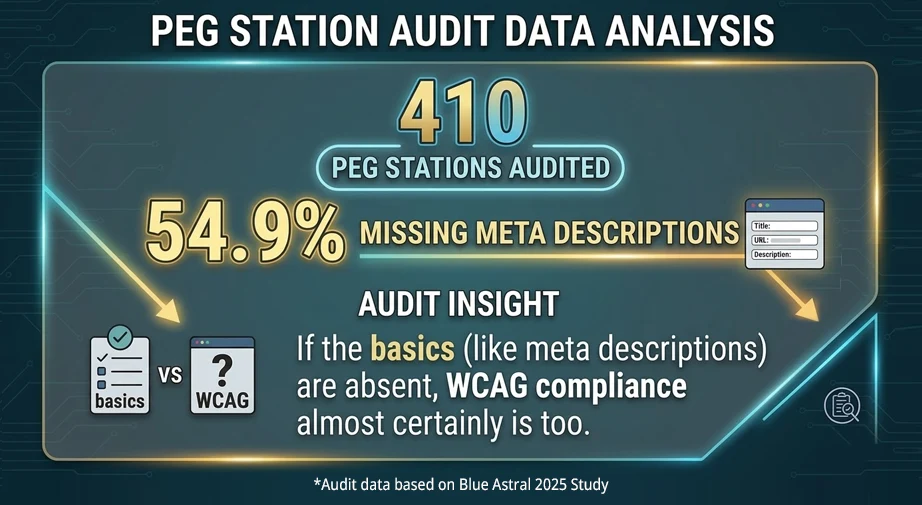
Blue Astral’s 2025 PEG Digital Readiness Study analyzed 410 PEG station websites. We did not audit WCAG compliance directly, but the structural patterns are telling.
The most relevant finding: 54.9% of PEG station websites are missing meta descriptions. This is a basic HTML hygiene indicator. Sites that lack meta descriptions almost certainly lack proper heading structure, alt text, and form labels, the building blocks of WCAG compliance. When a site is missing fundamental elements like these, the deeper accessibility work (keyboard navigation, ARIA labels, color contrast compliance) is almost certainly absent too.
The full study covers additional structural gaps across the 410 stations. For this article, the meta description finding matters because it is a reliable proxy for overall code quality, and WCAG compliance depends on that foundation.
The Enforcement Landscape Has Changed
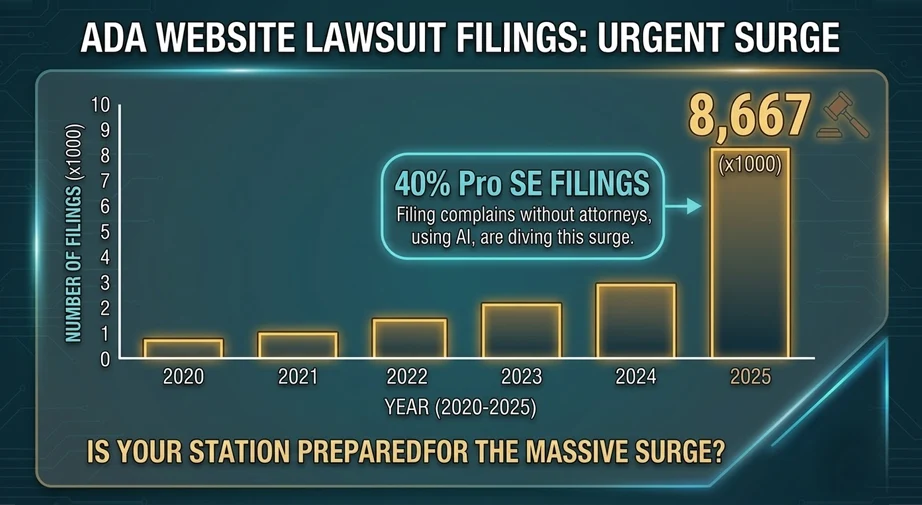
In 2025, 8,667 federal ADA website accessibility lawsuits were filed. That is a 37% surge over the prior year. A record $5.15 million class action settlement raised the stakes for every non-compliant organization.
The shift worth watching: AI-powered pro se filings. According to Seyfarth Shaw data, 40% of federal ADA Title III filings are now from self-represented plaintiffs using AI tools to draft complaints, identify violations, and file lawsuits that previously required a $5,000 legal retainer. Filing an ADA complaint has never been cheaper or faster.
PEG stations may feel distant from these numbers. The lawsuits so far have targeted e-commerce and private sector sites. But the DOJ can initiate investigations against any non-compliant public entity. Private citizens can file complaints. And the penalty structure, up to $150,000 per violation, plus potential loss of federal funding, can be devastating for organizations operating on $50K to $500K annual budgets.
Accessibility as Civic Mission, Not Just Compliance
PEG stations exist to serve their communities. The “P” in PEG stands for Public. The programming covers council meetings, school board hearings, local elections, and emergency information. These are civic essentials.
According to the CDC, 27% of U.S. adults live with some form of disability. When a PEG station’s website cannot be navigated by a screen reader, or its archived council meetings lack captions, those residents are excluded from the civic record their tax dollars fund.
Framing accessibility as a compliance burden misses the point. The stations that serve their community’s most vulnerable residents should be the most accessible, not the least. Accessibility remediation protects your station legally. More importantly, it fulfills the civic promise PEG stations were built on.
What PEG Stations Should Evaluate Now
With 48 days until the April 24 deadline, full WCAG remediation may not be realistic for stations starting from zero. But understanding exposure and building a roadmap is achievable. Blue Astral recommends four starting points:
- Determine your coverage status. Does your station operate under municipal authority? Receive government franchise fee funding? Serve a population over 50,000? If yes to any of these, the April 24, 2026 deadline likely applies. Smaller entities face an April 2027 deadline, but remediation typically takes 6 to 12 months.
- Run a baseline accessibility audit. Automated tools like WAVE or axe can identify surface-level issues (missing alt text, contrast failures, heading hierarchy problems). But automated tools miss 60-70% of accessibility issues. A manual audit with assistive technology testing provides the full picture.
- Prioritize video captioning. For PEG stations, video content is the biggest accessibility liability. Archived meetings without captions are a clear WCAG failure. Start with the most-viewed content and work backward.
- Document your remediation plan. Even if full compliance takes months, a documented plan with timelines shows good faith. The DOJ evaluates effort, not just current state.
A note on accessibility overlays: widget-based overlay tools marketed as quick compliance fixes have been widely criticized by disability advocates and are not recognized as meeting WCAG standards. Multiple organizations using overlays have still faced lawsuits. They are not a substitute for structural remediation.
FAQ
Q: Does ADA Title II apply to all PEG stations?
A: Most PEG stations operate under municipal authority and receive government franchise fee funding, which places them under Title II scope. The safest posture is to assume coverage and act accordingly, particularly for the “G” (government) channel operations that directly deliver government programming.
Q: What is the deadline for ADA Title II web accessibility compliance?
A: April 24, 2026 for public entities serving populations of 50,000 or more. April 26, 2027 for smaller entities and special districts.
Q: What are the penalties for non-compliance?
A: Federal penalties can reach $150,000 per violation. The DOJ can initiate investigations, private citizens can file complaints, and non-compliant entities risk losing federal funding.
Q: Can an accessibility overlay widget make our site compliant?
A: No. Overlay tools are not recognized as meeting WCAG 2.1 Level AA standards. Multiple lawsuits have been filed against organizations using overlays. Structural remediation of the underlying HTML, content, and functionality is required.
Q: How long does WCAG remediation typically take?
A: For a typical PEG station website, initial assessment takes 2 to 4 weeks. Remediation takes 3 to 9 months depending on site complexity, volume of video content requiring captions, and platform constraints.
Sources:
- ADA.gov: First Steps Toward Complying with Title II Web Rule – DOJ guidance on the final rule
- Accessibility.works: New ADA Title II Requirements – Deadline and scope details
- Accessible.org: 2026 ADA Compliance Predictions – 2025 lawsuit statistics and AI filing trends
- Accessibility.works: AI-Fueled ADA Lawsuits – Pro se filing data from Seyfarth Shaw
- BuzzClan: ADA Compliance Government Websites Deadline Guide – Penalty structure
- Link Electronics: ADA Compliance for PEG Channels – Title II applicability to PEG
- MRSC: April Deadline for Local Government Websites – Municipal compliance guidance
- Accessibility.works: Title II for Small Cities & Towns – Small entity deadline details